Outdoors, a mistake is not forgiven. The wrong fixture does not fail at once — it fails after the second winter, when the scaffolding has gone and the garden has been planted.
Under an eave, sheltered from direct rain: IP44 is enough. Exposed to rain: IP65. In the ground, where water collects: IP67. Underwater: IP68. These are not marketing tiers — they are tests, and an IP44 fixture set into a garden path will fill with water. In practice, failure comes more often from the cable and the junction box than from the fixture itself.
Step lights in stairs and low walls, so the light falls downwards and does not dazzle. Bollards along paths. Spikes among planting, aimed upwards at a tree or a stone wall. In-ground units where nothing may project above the surface. Wall lights at entrances and facades. Poles for car parks and public spaces. The rule is one: the eye should see the lit surface, not the source.
Salt air eats unprotected aluminium within a few seasons. In Dhërmi, Gjiri i Lalzit and Durrës the materials and treatments have to be different — specially coated aluminium, AISI 316 stainless steel, or composites. A fixture that is fine for Tirana is not necessarily fine for the coast, and that has to be said before the purchase, not after.
Outdoors the eye reads contrast, not quantity. A garden with a few chosen points looks larger and calmer than one flooded with light. And light that goes up into the sky or across into a neighbour’s window is wasted light — the design sets the aiming angle, not only the position.
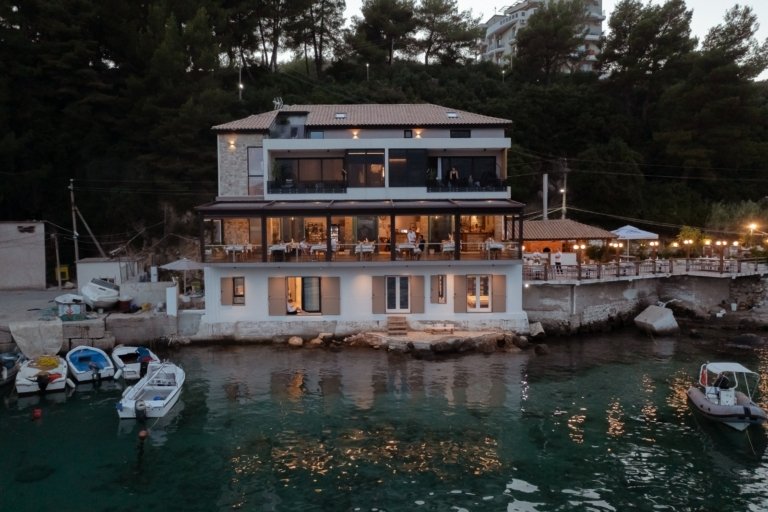
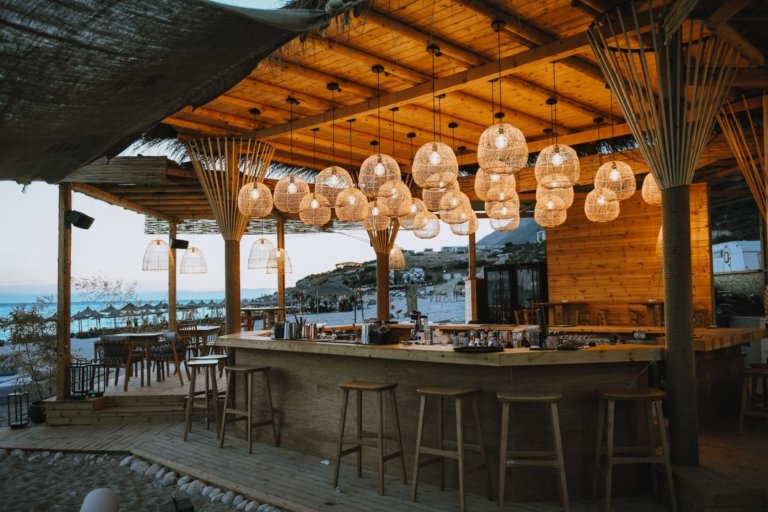
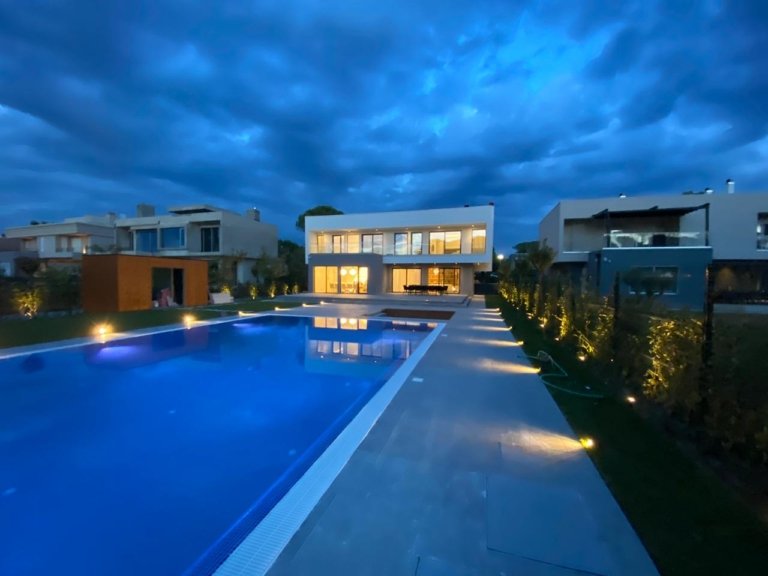
Twenty-two projects with outdoor areas: sea terraces at Luciano Dhërmi and Arti’s Blue Relax, the pergola at Kai Beach House, garden and pool at the Villa at Gjiri i Lalzit, and in-ground fixtures at Dot Lounge.
IP65 for fixtures above ground and IP67 for anything set into the ground, where water collects. Around and inside a pool, IP68 with cable of the same class.
Only those built for it. For coastal projects we select dedicated materials and treatments, and that changes both the choice and the cost — which is why location is the first thing we ask.
Yes, but with limits: running cable through a planted garden or under a finished path is construction work. If the project is still under way, laying empty conduit now costs very little and keeps every option open later.
Send us the plan or a few photos. We will tell you what the space needs — not what the catalogue happens to have.