
Poor office lighting doesn’t just cause visual discomfort — it can lower productivity, increase fatigue, and affect team mood throughout the day.
Ergonomics studies consistently show that good lighting isn’t a luxury, it’s a basic work requirement — just like a chair or a desk.
Ambient Light vs. Task Light
A functional office needs two levels of light working together:
- Ambient light — the overall light level of the space, usually from suspended profiles or ceiling panels, providing even visibility everywhere.
- Task lighting — additional focused light at the workstation, especially important for roles requiring detailed attention (design, accounting, editing).
Offices that rely on ambient light alone often create “dead zones” of work, where employees feel eye strain without understanding why.
Color Temperature and Focus
Light isn’t just “strong” or “weak” — its color directly affects mental state:
- 4000K (neutral-cool) — the standard choice for active work areas; helps alertness and focus during the early hours of the day.
- 3000K (warm) — more suitable for waiting areas, informal meeting rooms, or break spaces — creates a more relaxing atmosphere.
- Tunable white lighting — systems that change color temperature throughout the day, mimicking the sun’s natural rhythm, are becoming standard in modern offices to support employees’ circadian rhythm.
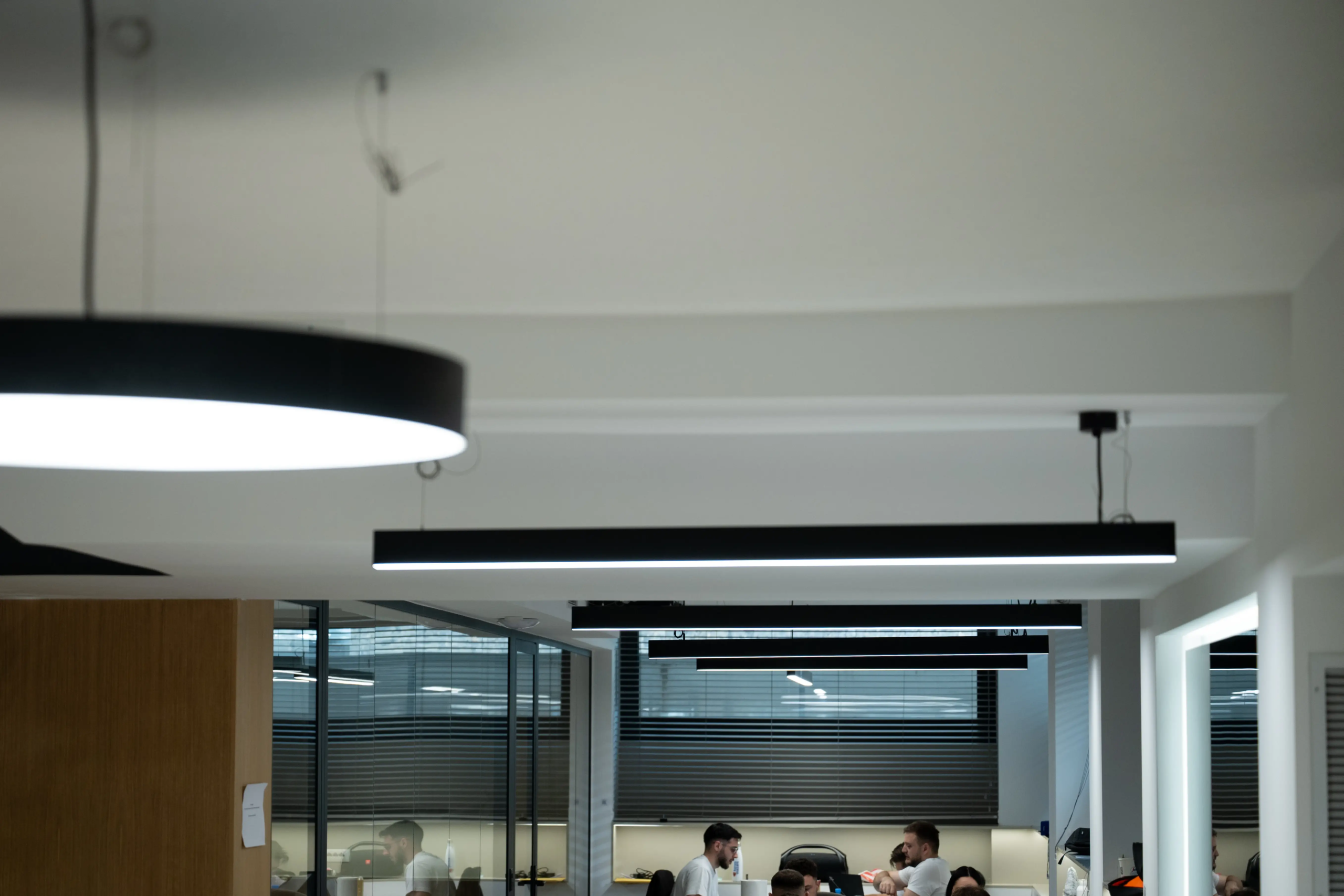
Screen Glare — the Most Underrated Problem
In offices with multiple monitors, reflections and glare are among the most common complaints, but also the easiest to avoid:
- Avoid fixtures placed directly above or behind a screen — they create direct reflection into the eyes.
- Use diffusers instead of exposed light sources, especially with low ceilings.
- Position desks at an angle to windows, not directly facing or with your back to them — strong natural light causes just as much glare as artificial light.
Meeting Rooms and Collaboration Areas
These spaces need flexibility: strong, neutral light for presentations and group work, but the option to lower intensity when using a projector or large screen. Dimmer systems or adjustable track lighting make this transition easy, without needing two separate installations.
Good office lighting never looks like anything special — it just makes the workday less tiring. That’s exactly why it’s worth planning carefully from the start, not as an afterthought once the furniture is arranged.